Saturday, 10 June 2017

Sunday, 4 June 2017
Thursday, 1 June 2017
Jan Švankmajer

Jan Švankmajer is a filmmaker and artist recognised for his surreal animations, he was born on the 4th of September 1934 in Prague, Czechoslovakia. He has inspired many of today’s stop-motion animators, including Tim Burton and The Brother Quay. Jan is known for his dark reimagining of well-known fairy tales and for his avant-garde usage of three-dimensional stop-motion coupled with live-action animation. Several critics hailed him for favouring visual elements over plot and narrative, other for his use of dark fantasy.
He has achieved his reputation over the years for his creepy and surreal films, utilizing distinctive stop-motion technique, counting (Pixilation and Claymation). Jan still remains to produce stop-motion films today. Jan tends to project a moral within his stop-motion animations, the animation per say usually makes no sense, however, when watching it closely it emits a deeper meaning in it, and that is the purpose of surrealism.
Jan’s stop-motion films are very weird and disturbing to watch, yet it conveys vital information’s that has to be focused on in order to realise what they are, this keeps the viewers glued to the movie and makes Jan Švankmajer’s movie so appealing to his ever-growing audience.
Švankmajer pursued an interest in theatre and puppetry. He studied at the School of Applied Arts in Prague from 1950-1954 prior to enrolling in the puppetry department at the Academy of the Performing Arts. Jan also worked at a marionette theatre and other theatres in the city. Švankmajer discovered an appreciation for the film through his theatre work and soon began his cinematic career journey. His first short- Poslední trik pana Schwarcewalldea a pana Edgara- 1964 (The Last Trick), in which 2 magicians contribute in a heated competition of skill – provided evidence of his early interest in stop-motion.
Švankmajer’s most recognised work, Lekce Faust (1993: Faust), provided a new spin to the familiar tale of the Faustian bargain. The film is set in a foreboding puppet theatre that pulls the main character inside. There he experiences a bizarre form of the Faust play, which comprises of giant puppets and clay figures filmed in stop-motion.
Even though Švankmajer won more than 30 awards and honours from several international film festivals, he is still relatively unfamiliar in North America throughout most of his career. His lack of reputation was in large measure a result of political events that took place in Czechoslovakia. After the invasion of the Soviet Union in that country in 1968, the powers that be constrained opportunities for Švankmajer’s films to reach a wider audience, finding his work generally inappropriate for their desired ends. Nevertheless, Švankmajer’s reputation grew substantially after the fall of the Soviet Union.
Švankmajer picked up a respectable standing throughout the following couple of decades for his exceptional style of stop-motion animation, and his capacity to make really startling nightmarish surreal but then in some cases funny motion pictures. Utilizing a great deal of exaggerated sounds to make peculiar impacts, frequently in eating scenes, on the audience to make a surreal atmosphere. He utilizes a lot of speed changes, more often than not when individuals are talking or walking to make a strained and emotional impact. A large portion of his movies frequently involve food, this is by all accounts his most loved subject and making lifeless articles come to life through stop-motion animation. The individuals who make the most of Švankmajer's work will appreciate it due to its visual stimulation and it's really disturbing and forceful sequences. His works are extremely fascinating and inventive, however, at times they could be depicted as pushing against the limits in some respects.
BIBLIOGRAPHY
- Yalzadeh, I. (2017). Jan Svankmajer | Czech artist, puppeteer, animator, and filmmaker. [online] Encyclopedia Britannica. Available at: https://www.britannica.com/biography/Jan-vankmajer [Accessed 1 Jun. 2017].
Raymond Frederick "Ray" Harryhausen

"Godfather of visuals effects in 24 frames"
Raymond Frederick "Ray" Harryhausen was an American-British artist, designer, visual effects creator, writer, and producer who created a form of stop-motion model animation known as "Dynamation". He was born 29th June 1920 and passed away at the age of 92 on 7th May 2013. Harryhausen was inspired by Willis O’Brien’s animation in ‘King Kong’, this drive was what gave Harryhausen to venture into the field of stop-motion animation.
He came up with some of the most cutting edges and most fascinating stop motion techniques and films ever created. Harryhausen’s style was easily identifiable, models (mostly Claymation) were highly thorough and physiques were extremely close to realism. Harryhausen invented his own stop-motion method which undoubtedly completely transformed the utilization of stop-motion, expanding its use and created it in such a way making it more seamlessly fit in, to the extent that it was capable of being in the same scene as actors and such, which till now was not possible. He was the idol for several modern animators that are famous today.
This video is from ‘Jason and the Argonauts’, it projects Harryhausen’s utilization of Dynamation. The skeletons are models that are functioned by hand and are made to look like they are alive. This is technique is used by several animators today, for instance, Aardman, Tim Burton). In his films, the models, interact with the live-action world, that will cease to call attention to themselves as ‘animation’.
What is Dynamation and its function?
Overlaying of an image upon another, this would allow stop-motion models could be work with the images overlaid on the live action film. This gives it a realistic feel and as if they are interacting with the actors, completely advancing viewing quality. The process was incredibly simple, a projector would project the still images of the film onto a rear screen, then the models would be placed in front of this, a glass screen would be placed in front of the models. This was utilized to eliminate the surroundings (i.e. the setting, walls, furniture etc), the camera would then take a picture of the models through the glass pane, this sets up act like layers in effect and create a single 2D still.
The illustration below explains the process step by step:

The primary advantage of this process of the massive enhancement in terms of visual quality and transition of stop-motion in live action films. With the pros always comes the cons, this process increased the creation time because of the film needing to be completely filmed and then get the models manipulated and overlaid. The increased cost of creating a film using this specific method and due to the additional equipment made it harder to carry on with.
He got his first job working on George Pal’s Puppetoons shorts. Via that he worked for the Special Services Division under Col Frank Capra as a loader, clapper boy, gaffer and afterwards as a camera assistant amid WW2. Amidst doing this we also worked on his own short films at home animating short films about the deployment and uses of military equipment.
Colour Film

Harryhausen began playing with colour film amid the making of a documentary called ‘The Animal World’. He played with various colour sticks to overcome the colour-balance and light-shift problems he faced. He was requested to assist by Willis O’Brien who was struggling to meet the short deadline set to complete the eight-minute-long dinosaur sequences. This was Harryhausen’s first ever professional colour work and was the first sequence shown in the film. This was the top-grossing film of the summer and again one of the top three grossing films of the year.
He soon met and started a beneficial association with maker Charles Schneer, who was working with the B-Picture unit of Columbia Pictures. Their first sci-fi feature film was 'It Came from Beneath the Sea' released in 1955. It was about a Goliath octopus-like creature that originated from the ocean and began attacking San Francisco and was a colossal box office success. This was immediately trailed by 'Earth vs. the Flying Saucers' that was released just a year later in 1956. A setting in Washington D.C and was about the planet Earth confronting an Alien intrusion. This was one of the best and top grossing intrusion movies of the 50's and was likewise a major box office hit.
 Amid the mid-1970's and completely through to the 2000's Harryhausen composed many books, novels and fantasy scrapbooks'. These were intended to guide and move young animation pioneers of the new Century Some fundamental titles were ‘Ray Harryhausen: An Animated life', 'A Century of Model Animation: from Melies to Aardman' and the most recent of his books that was distributed 2011; ‘Ray Harryhausen's Fantasy Scrapbook' which sold extremely well. He additionally made enormous production movies close by his written passion that has propelled revamps in the turn of the new Century, e.g. 'The Golden Voyage of Sinbad' and ‘Clash of the Titans’.
He was the closest thing these pictures had to an auteur, and his effects were their primary box office draw, yet he died without a single feature-film directing credit on his IMDb page. His disciples knew the truth, the majority of them turned out to be filmmakers themselves, and tried to summon some of the imagination and personality of Harryhausen’s creation in their own work. Without Harryhausen The Lord of the Rings, the T. rex-raptor fight in Jurassic Park, the Rancour from Return of the Jedi, or the skeleton horse in Army of Darkness; we probably would not have gotten Peter Jackson, Steven Spielberg, George Lucas, or Sam Raimi, either.
The technology that allowed Spielberg to inhabit Isla Nublar with thunder lizards far outstripped anything Harryhausen (who retired when CGI was in its infancy, and never touched the stuff) had at his disposal. Stop-motion is simpler, yet harder. It is deeply tedious and labour-intensive way of generating cinematic illusions, and cheaper/easier/more “realistic” effects have vastly outdated it by the time Harryhausen retired.
Nevertheless, Harryhausen’s monsters existed in the physical world, even if it took camera trickery to project them onscreen with human actors. It had an essence of something believable and tactile about them, even if you knew they were actually the size of toys. They captured the light, cast shadows. They seemed forged but felt real
BIBLIOGRAPHIES
- Gilsdorf, E. (2013). Why Ray Harryhausen's stop-motion effects were more real than CGI. [online] Boing Boing. Available at: http://boingboing.net/2013/06/03/long-live-real-fake-fx.html [Accessed 1 Jun. 2017].
- Pappademas, A., Barnwell, B., Lindbergh, B. and Phillips, B. (2013). R.I.P., Ray Harryhausen. [online] Grantland. Available at: http://grantland.com/features/a-tribute-ray-harryhausen-godfather-visual-effects-24-frames/ [Accessed 1 Jun. 2017].
Willis “Obie” O’Brien

He was on March 2nd, 1886 and passed away on November 8th, 1962. While unappreciated in his lifetime, Willis “Obie” O’Brien’s mastery of animation has inspired the mind’s eye of generations. This pioneer’s monstrous legacy was educated through years of developing innovative techniques. Willis was an Irish American and he pioneered motion pictures special effects and is most recognised for his sciences fiction films; ‘The Lost World’, ‘King Kong’ and ‘Mighty Joe Young’ for which he won the Academy Awards for ‘Best Visual Effects’ in 1950. He began his careers as a cartoonist for the San Francisco Daily News and was also a professional marble sculptor.
The Oakland-born California native expanded life experience prior to jumping into motion pictures. His winding artistic journey started in his teens working briefly as a cowboy, boxer and cartoonist. Their interests would rise in his later works. He made models, mainly featuring dinosaurs and caveman, and with the help of the local news camera crew he animated the figures and generated a minuscule stop-motion piece. Successfully capturing the attention of the Edison Company and was funded to make his first film ‘The Dinosaur and the Missing Link: A Prehistoric Tragedy’ in the year of 1915 with a spending plan of $5,000. Later his was requested to animate a series of Prehistoric themed short films for the company, these were the first stop-motion films to associate live actors with stop-motion models. The films grossed over $100,000 and the Director Dawley gained most of the credit and then eventually went on to utilize the effects for sequel ‘Along the Moonbeam Trail’ and his documentary ‘Evolution’. O’Brien got a small-scale financial compensation for his successful film.
Herbert M. Dawley with a duck-billed dinosaur he built for ‘Along the Moonbeam Trail’, circa 1920.

From the niche point of view of visual effects history, this is bombshell material, specifically for those who reverence for O’Brien runs deep.

His character typically consisted mainly of clay, especially in his early pieces of work. The intricacy of his models grew with the advancement of his career and skills. He would create models with complexly articulated armatures covered with rubber skins, some of his designs would even include a rubber bladder that allowed his creatures to “breathe”. By inflating and deflating the bladder, his creatures could fight, move, and also give the sense of breathing- stirring both the audiences’ fears and imaginations. In King Kong, he created movement via the utilization of an armature that is covered with hair, and he moves the body a slight bit at a time and captures it. This technique is adopted with by most of the stop-motion animators of today (Aardman in ‘Chicken Run’ Tim Burton in ‘Nightmare Before Christmas’) etc.

In order to advance his projection of the mighty Kong, O’Brien frequently visited zoos to study the Gorilla’s movements. He would also go to wrestling matches to study their interactions and enhance the choreograph of his creatures’ battles.
Kong’s nourishing character coupled a new style of rear projection film effect left audiences elated and amazed – exceeding all previous films of its type. The gentle giants winning performance was as strong as the films special effects.
Using this method as the background today, live action fused with stop-motion animation is a modern standard procedure. A cellulose acetate screen was utilized for rear projection for the first time ever. This new fabric of cellulose screen was flexible and stretched over a frame like canvas. Willis also started using a blue screen behind live action actors permitting them to be matted into existing footage. This method, as well as rear and miniature projection, enhance the optical procedure. Till computer animation was widely utilized, these practices were used in most monster films until the 1990’s.
Willis carried on writing concepts for many films after ‘King Kong’ but only found the backing to complete a few. Amid filming the follow-up feature ‘Song of Kong’, tragedy would strike into Willis’ life. Hazel, O’Brien’s ex-wife would progress to shoot and kill both of their sons and then turn the gun on herself. While tormented with grief, O’Brien forged on labouring in anonymity, gaining neither fame nor fortune.
Now known to the world as the man who made Kong, O’Brien is equal as a legend amongst horror, dinosaur and animation fans. In 1950, he achieved a special Oscar for his work on ‘Mighty Joe Young’. Ray Harryhausen worked alongside O’Brien during the production of Mighty Joe Young while some would say did the majority of the animation. He was credited as the technical creator and was soon awarded the Academy Award for Best Visual Effects. Six years later he worked with Harryhausen again, for the famed dinosaur sequence in Irwin Allen’s nature documentary ‘The Animal World’ in 1956.
‘It’s a Mad, Mad, Mad, Mad World’ was the last of his animation project, featuring few of the main characters dangling from the fire escape by a ladder, but sadly kicked the bucket before the completion of the film. Following his passing, he was posthumously awarded the Winsor McCay Award by ASIFA-Hollywood (The American Association Internationale Du Film d’Animation) for lifetime/career contributions to the art of animation in 1997.
Willis O’Brien has been an inspiration to several, conjuring up wonderful worlds of fantasy and wonder. Through solitary in his life’s work, he set the foundation that we all can build and grow upon.
BIBLIOGRAPHIES
- Shay, D. (2014). Willis O’Brien Revisited. [Blog] Cinefex. Available at: http://cinefex.com/blog/willis-obrien-revisited/ [Accessed 1 Jun. 2017].
- Wold, K. (2014). Willis O'Brien - The Man who Created Kong. [Blog] Animate Clay- Stop Motion Network. Available at: https://www.animateclay.com/index.php/articles/11-stop-motion-pioneers/44-willis-o-brien-the-man-who-created-kong [Accessed 1 Jun. 2017].
Sunday, 28 May 2017
Tuesday, 23 May 2017
The PRAXINOSCOPE

The Praxinoscope was invented in 1877 by the Frenchman Charles Reynaud. It was the first device to overcome the picture distortion triggered by viewing through moving slots. The images produces brought a change and was advanced that any other previous devices. Due to this advance, it was instantly replaced the Zoetrope in popularity.
The fusion of moving picture 'toys' and vaudeville (show/entertainment) exhibition devices such as the magic lantern was unavoidable and one of the first successful attempts at such a marriage came in the form of the Praxinoscope. In essence, it was an adaptation of Horner's Zoetrope which at the time had become extremely popular.
Using a drum designed which revolved, as with the Zoetrope, a band of pictures is placed inside a shallow outer cylinder, so that each pictures is bounced back off by the inner set of mirrors. The number of mirrors is equal to the number of pictures, and the images of the pictures are viewed in the mirrors. When the outer cylinder rotates, the quick succession of reflected pictures provides the illusion of a moving picture.
The result was flawless animation without the sense of loss of luminosity in movement which was evident with the Zoetrope.

Reynaud upgraded the existing device so that the animated pictures could be projected. The replacement of the opaque drawings with transparent drawings meant that light could be shone through them. The mirror prism reflected the light that was shone though the pictures, and focused it onto a screen through a lens.
In 1872 Reynaud took this idea and altered it into theatrical entertainment. Animation toys had been limited to repetitive images. Reynaud recorded this and devised a method of painting a series of pictures on small glass plates which fused together in a single flexible strip. The animate characters were project onto a screen from behind. He called this the "Theatre Optique", he utilized a long roll of paper to increase the number of images, and thus was able to make a much longer show for an audience.
Reynaud displayed his projecting Praxinoscope providing public performances utilizing long broad strips of hand painted frames. The response was successful but was jerky and slow. In addition to this, labour needed to draw the strips meant that Reynaud's films could not easily be reproduced.
Reynaud's Theatre Optique created a huge name and was really close to the cinema- all that it lacked was the addition of photography.
BIBLIOGRAPHIES
- Courses.ncssm.edu. (n.d.). Praxinoscope, Top View. [online] Available at: http://courses.ncssm.edu/gallery/collections/toys/html/exhibit11.htm#top [Accessed 23 May 2017].
- Earlycinema.com. (n.d.). EarlyCinema.com. [online] Available at: http://www.earlycinema.com/technology/praxinoscope.html [Accessed 23 May 2017].
The PHENAKISTISCOPE
It was an early animation device made by Joseph Plateau ,
it was inspired by Faraday's wheel Joseph Plateau in Brussels and Simon von Stampfer in Vienna invented the Phenakistiscope independently of one another in 1832. Stampfer called it the stroboscope in England it was known as the Fanta Scope. The phenakistiscope utilizes the persistence of motion principle to create an illusion of motion. Although this principle had been recognised by the Greek mathematician Euclid and later in experiments by Newton, it was not until 1829 that this principle became firmly established by Joseph Plateau.
The device was created just after the Zoetrope and its reception was much better received. This device like majority of the stop motion animation utilizes the theory of persistence of vision for it to function. Persistence of vision was a theory of the optics and how eyes view images.
It sound very similar to the Zoetrope using a circular disk attached to a mount which permitted it to rotate 360 degrees. Phenakistiscope was a device taken in much better than the others that were around at that time. This was due to the fact that it was more condensed in size and it is very easy to change disks. In addition, it was the first portable animation device, meaning that they were very much desirable than other early animation devices and came in trend under the name of toys.
The Phenakistiscope is quite unique when compared to other animation devices, though they use the same technique to animate, such as a rotating drum, and 'windows', they are actually rather different from an engineering standpoint. The Zoetrope is a upright device which the drum rotates along the horizontal axis. Meaning that it can be set on a surface and looked straight through. Where as the Phenakistiscope is meant to be portable and as such rotate along the vertical axis. So it was very popular and is very good for animation on the go, but it typically was of much lower quality in terms of materials and durability, which resulted in a fragile device. Another major distinctive element with these two animation devices often seen as being the same (but one a portable version) is the Phenakistiscope did not have a light source attached, thus natural light was necessary to utilize it or a well lit room, however the Zoetrope (not all models) didn't need as much light due to the fact that it wasn't portable. You are able to use it in the dark, this was later picked up on and the Zoetrope was expanded to be one of the first 'night lights' used as a children 'bedtime' lamp. This was accomplished by having the still images cut out and held in place rather than being stuck to the inside of the drum, when the low key light hit them a shadow would be projected on the ceiling, further improvement on positioning of these also lead to the projection being animated. This could have perhaps been some of the earliest forms of projectors.
BIBLIOGRAPHY
The
phenakistoscope consisted of two discs mounted on the same axis. The
first disc had slots around the edge, and the second contained drawings of
successive action, drawn around the disc in concentric circles. Unlike
Faraday's Wheel, whose pair of discs spun in opposite directions, a
phenakistoscope's discs spin together in the same direction. When viewed
in a mirror through the first disc's slots, the pictures on the second disc
will appear to move.
The device was created just after the Zoetrope and its reception was much better received. This device like majority of the stop motion animation utilizes the theory of persistence of vision for it to function. Persistence of vision was a theory of the optics and how eyes view images.
It sound very similar to the Zoetrope using a circular disk attached to a mount which permitted it to rotate 360 degrees. Phenakistiscope was a device taken in much better than the others that were around at that time. This was due to the fact that it was more condensed in size and it is very easy to change disks. In addition, it was the first portable animation device, meaning that they were very much desirable than other early animation devices and came in trend under the name of toys.
The Phenakistiscope is quite unique when compared to other animation devices, though they use the same technique to animate, such as a rotating drum, and 'windows', they are actually rather different from an engineering standpoint. The Zoetrope is a upright device which the drum rotates along the horizontal axis. Meaning that it can be set on a surface and looked straight through. Where as the Phenakistiscope is meant to be portable and as such rotate along the vertical axis. So it was very popular and is very good for animation on the go, but it typically was of much lower quality in terms of materials and durability, which resulted in a fragile device. Another major distinctive element with these two animation devices often seen as being the same (but one a portable version) is the Phenakistiscope did not have a light source attached, thus natural light was necessary to utilize it or a well lit room, however the Zoetrope (not all models) didn't need as much light due to the fact that it wasn't portable. You are able to use it in the dark, this was later picked up on and the Zoetrope was expanded to be one of the first 'night lights' used as a children 'bedtime' lamp. This was accomplished by having the still images cut out and held in place rather than being stuck to the inside of the drum, when the low key light hit them a shadow would be projected on the ceiling, further improvement on positioning of these also lead to the projection being animated. This could have perhaps been some of the earliest forms of projectors.
BIBLIOGRAPHY
- Courses.ncssm.edu. (n.d.). Phenakistiscope. [online] Available at: http://courses.ncssm.edu/gallery/collections/toys/html/exhibit07.htm [Accessed 23 May 2017].
The ZOETROPE
It was a very primitive animation device, originated in 180AS by Tin Huan under the name of 'chao hua chich kuan' (the pipe that makes fantasies appear), it was utilizes as a way of warding off spirits, rather than entertainment.
It wasn't reinvented until 1834 by William Horner (mathematician), who originally called it a Daedalum ("wheel of the Devil"). It is similar to Plateau's Phenakistoscope, but was more convenient since it did not need a viewing mirror and let more than one person to use it at the same time. His invention for some reason became forgotten for nearly 30 years until 1867, when it became patented in England by M. Bradley, and in America by William F. Lincoln. Lincoln renamed the Daedalum, giving it the name of "Zoetrope", or "Wheel of Life".
The Zoetrope is the 3rd major optical toy, after the Thaumatrope and Phenakistoscope, that utilizes the persistence of motion principle to create an illusion of motion. It is a simple drum with an open top, supported on a central axis. A sequence of hand-drawn pictures on strips of paper are placed around the inner bottom of the drum. Slots are cut at equal distances around the outer surface of the drum, just above where the picture strips were to be positioned.
In order to create an illusion of motion, the drum is spun; the faster the rate of spin, the smoother the progression of images. A viewer can look through the wall of the zoetrope from any point around it., and see a rapid progression of images. Since of its design, more than one individual could use it at the same time.
It wasn't a very fruitful animation device, partially due to the Phenakistoscope being released so closely. There has been various forms of Zoetrope and spin offs from the initial device all altering the method utilized to exhibit and make it easier to view. A good example of this was the use of a centre pole which had mirrors attached to it, this would reflect the images off the paper in the middle and eliminated the need for viewing windows.
Zoetrope is pretty much extinct now, it is an impractical way to animate because of its limited frames available, increasing the number of images results in either scaling the device up, consuming more space and money, or making the images smaller, which will end up making it harder to observe animations as the sizes are minimized.
Modern day Zoetropes' are created utilizing modern engineering and digitalisation to make a device with no limit to frames, this works by rather than using paper and TV screens. Each projected distinctive images that would swap when they were used, meaning longer production could be made, nevertheless, the creation of this modern spin was a gimmick more than any form of evolution.


BIBLIOGRAPHY
It wasn't reinvented until 1834 by William Horner (mathematician), who originally called it a Daedalum ("wheel of the Devil"). It is similar to Plateau's Phenakistoscope, but was more convenient since it did not need a viewing mirror and let more than one person to use it at the same time. His invention for some reason became forgotten for nearly 30 years until 1867, when it became patented in England by M. Bradley, and in America by William F. Lincoln. Lincoln renamed the Daedalum, giving it the name of "Zoetrope", or "Wheel of Life".
The Zoetrope is the 3rd major optical toy, after the Thaumatrope and Phenakistoscope, that utilizes the persistence of motion principle to create an illusion of motion. It is a simple drum with an open top, supported on a central axis. A sequence of hand-drawn pictures on strips of paper are placed around the inner bottom of the drum. Slots are cut at equal distances around the outer surface of the drum, just above where the picture strips were to be positioned.
In order to create an illusion of motion, the drum is spun; the faster the rate of spin, the smoother the progression of images. A viewer can look through the wall of the zoetrope from any point around it., and see a rapid progression of images. Since of its design, more than one individual could use it at the same time.
It wasn't a very fruitful animation device, partially due to the Phenakistoscope being released so closely. There has been various forms of Zoetrope and spin offs from the initial device all altering the method utilized to exhibit and make it easier to view. A good example of this was the use of a centre pole which had mirrors attached to it, this would reflect the images off the paper in the middle and eliminated the need for viewing windows.
Zoetrope is pretty much extinct now, it is an impractical way to animate because of its limited frames available, increasing the number of images results in either scaling the device up, consuming more space and money, or making the images smaller, which will end up making it harder to observe animations as the sizes are minimized.
Modern day Zoetropes' are created utilizing modern engineering and digitalisation to make a device with no limit to frames, this works by rather than using paper and TV screens. Each projected distinctive images that would swap when they were used, meaning longer production could be made, nevertheless, the creation of this modern spin was a gimmick more than any form of evolution.

In conclusion, the device itself is a very old and interesting attempt at an animation device, primarily used as a source of entertainment but its value is interfered by its frame limitation. Nevertheless, the size of this animation device does mean it was both affordable and usable in homes.

This is what a viewer would see before looking through the slots. The space between every two slots tend to darken the movie image.
BIBLIOGRAPHY
- Courses.ncssm.edu. (n.d.). Zoetrope, Top View. [online] Available at: http://courses.ncssm.edu/gallery/collections/toys/html/exhibit10.htm [Accessed 23 May 2017].
Friday, 19 May 2017
Sunday, 14 May 2017
Frame Rates
DEFINITION:
Each individual image or picture in an
animation is referred to as a frame. The more frames utilizes the slower the
action will appear, and using fewer frames would create a faster action. Small
movements tend to be smooth when compared to large movement as it will either
be jerky or animation won’t take place. Typically, smooth actions are slow and
use a lot of frames.
What is it?
Traditional animation uses 24 frames for
every second. This is recorded as 24FPS (Frames per Second). However, some
modern animators only use 12 FPS.
We all know the motion picture is a lie. The movement on the screen we see is just a bunch of still images. Still images that seem more like believable, realistic, lifelike motion the faster they flicker along. The faster the better, and that 48 frame-per-second version of The Hobbit was just the beginning.
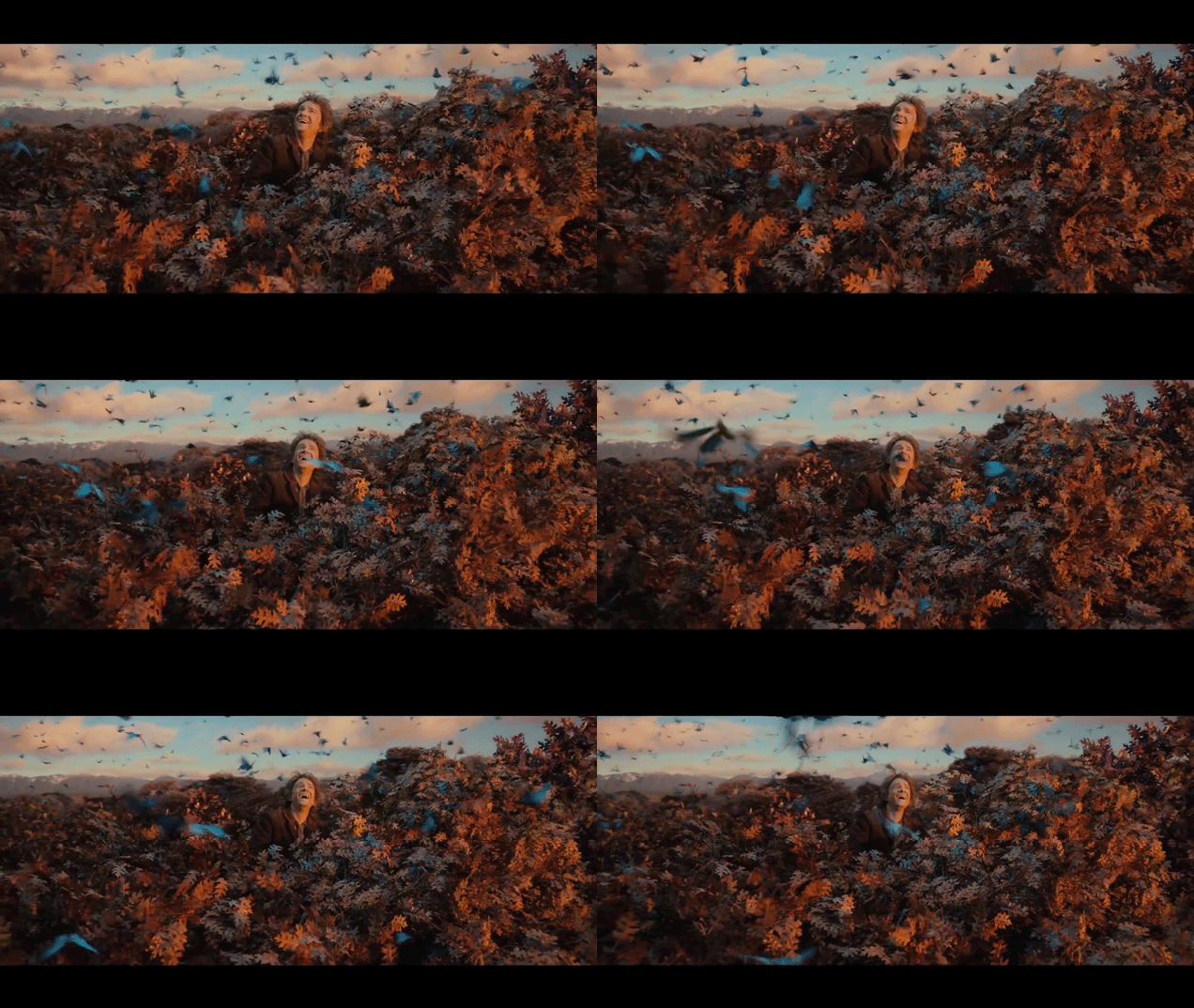
The rate at which these frames are shown is exhibited in frames per second (FPS) for conventional celluloid film, and as a "refresh rate" measured in hertz (Hz) for digital films and display monitors. In both cases, the value shows how rapidly the still images can flicker, and the faster they can flicker, the more lifelike and natural the motion appears.
FPS and refresh rate are similar, however they are not exactly the same. It all starts back from an old projectionist trick. In order to decrease the jumpiness of 24 FPS films (the standard speed), projectionists would flash the same frame 2 or 3 times before the next frame came up. The frame rate is the number of complete still images projected every second- so that would be 24 FPS- yet the refresh rate is the total sum of times any image flashes over the course of a second, in this case it would be 72 Hz. Thus a 24 FPS film can still have a refresh rate of 72 Hz if each frame is being projected 2 times, or a refresh rate of 48 Hz if they're only being flashed twice.
How is it seen?
The human eye can identify the difference between 10 and 12 still images per second before it starts just seeing it as motion. That is, at an FPS of 12 or less, the brain knows that it is just a bunch of still images in rapid series, not a seamless animation. Once the frame rate rises up to around 18 to 26 FPS, the motion effects tends to take effect on the brain and fools it into thinking that the individual images are actually a moving scene.

We all know the motion picture is a lie. The movement on the screen we see is just a bunch of still images. Still images that seem more like believable, realistic, lifelike motion the faster they flicker along. The faster the better, and that 48 frame-per-second version of The Hobbit was just the beginning.
The rate at which these frames are shown is exhibited in frames per second (FPS) for conventional celluloid film, and as a "refresh rate" measured in hertz (Hz) for digital films and display monitors. In both cases, the value shows how rapidly the still images can flicker, and the faster they can flicker, the more lifelike and natural the motion appears.
FPS and refresh rate are similar, however they are not exactly the same. It all starts back from an old projectionist trick. In order to decrease the jumpiness of 24 FPS films (the standard speed), projectionists would flash the same frame 2 or 3 times before the next frame came up. The frame rate is the number of complete still images projected every second- so that would be 24 FPS- yet the refresh rate is the total sum of times any image flashes over the course of a second, in this case it would be 72 Hz. Thus a 24 FPS film can still have a refresh rate of 72 Hz if each frame is being projected 2 times, or a refresh rate of 48 Hz if they're only being flashed twice.
1 second
|
24
Frames
|
10 seconds
|
240
Frames
|
A 30 second animated advert
|
720
Frames
|
1 minute
|
1,440
Frames
|
A 10 minute children’s animated TV programme
|
14,400
Frames
|
A 30 minute animated TV programme
|
43,200
Frames
|
A 90 minute animated feature film
|
129,600
Frames
|
The human eye can identify the difference between 10 and 12 still images per second before it starts just seeing it as motion. That is, at an FPS of 12 or less, the brain knows that it is just a bunch of still images in rapid series, not a seamless animation. Once the frame rate rises up to around 18 to 26 FPS, the motion effects tends to take effect on the brain and fools it into thinking that the individual images are actually a moving scene.
If a frame rate is too slow, the motion will look jagged, but being too fast can also cause problems too. Live-action movies filmed at 48 FPS usually have that certain soap-opera effect people aren't really fond of and this is slightly evident in The Hobbit. This is due to one major component of making the motion seem real and lifelike is motion blur.
The current industry standard is 24 FPS- that figure was mainly decided on for economic rather than theatrical purposes, yet more on that in a second- and that's what's determined what movies look like for use. However that is hardly the maximum we can see. Both current technology and the innate visual ability of the human eye can handle far higher rates than what we see on TV.
A frame rate for every media
Lately cinematic rates have been getting undercut by the economic interests of the moving-making industry. The earliest silent movie were shot at around 16 to 20 FPS- since that was the bare minimum that generated the continuous motion effect- though limited due to the arm strength of the cameraman, who would actually have to crank a reel of film through the camera.
Thomas Edison was a very early follower of higher frame rates. When Talkies hit in 1926, projectionists could no longer vary the frame rate on the fly like they were able to, as it would throw off the pitch of the sound playback, meaning that the film industry had to choose a stable frame rate at which to project. The industry settled on 24 FPS, mainly based on the fact that it was the slowest (and thus least extensive to produce) frame rate that could still support audio when played from a 35mm reel.
Now we have 3 primary frame rate standards- 24p, 25p, and 30p and the alternative frame rates include 48p, this is what Peter Jackson used to film The Hobbit. If we go higher there is 90p and 100p, which are options on the GoPro Hero, and 120p, which is the new standard in UHD televisions. The highest current commercially available frame rate is 300 FPS, which the BBC has been utilizing for some of its sports broadcasts.
BIBLIOGRAPHY:
Tarantola, A. (2015). Cite a Website - Cite This For Me. [online] Gizmodo.com. Available at: http://gizmodo.com/why-frame-rate-matters-1675153198 [Accessed 14 May 2017].
Wednesday, 10 May 2017
STOP-MOTION ANIMATION
It is also referred to as Stop Frame Animation. It animation that is captured one frame at a time, with physical objects that are moved between frames. When you replay the images rapidly, it generates the illusion of movement. The basic procedure of animation involves taking a photograph of your object or characters, moving them slightly, and capturing another photograph. When you replay the images consecutively, the objects or characters look like they are moving on their own.
Stop motion animation takes place everywhere- commercials, music videos, television shows and feature films- even if you don't realise it. While it is normal for people to think of stop motion as just one specific style, like clay animation, the reality is that stop motion techniques can be utilized to create a wide range of film styles:
Examples of Stop Motion Animation Feature Films:
An example of Stop Motion Animation TV Show/ Cartoon:
An example of Stop Motion Animation Music Video:
An example of Stop Motion Animation Advert:
Stop-motion animation is conducted using a simple process. The artist place all the articles to be animated in their initial positions. An image of the objects is then captured on film or an another media such as a memory card. Then the articles positions are slightly altered and another image is captured. Normally, this is done minimum hundreds of times.

For instance, if you want to create a video utilizing stop-motion animation featuring a bunch of pens that move in a circular pattern. You would have to begin by positioning the pens in a circle and take a picture of it. Alter the pens slightly in a clockwise direction and capture it again. Do this process over and over until you have captured hundreds of photographs. You then transfer the images on to the computer where you will have to use special software in order to create a video which rapidly projects the photographs chronologically. As you play the video, the pens move in a circle just as you would have wanted it to. This is stop-motion animation.
Early Stop-Motion Animation
Early stop motion was taken with film cameras. Animators wouldn't be able to see how it's turned out until the film has been processed. They utilized surface gages in order to keep track of where the artists were, and how far to move them. On the off chance that the animation didn't turn out to be fluid, if the set had been bumped, or if the lighting was bad, work was lost and the animator would have had to start it all over again.
After when the special video machine were invented, it allowed the animator to watch the last one or two frames, and compare those to the live video from the camera. This permitted then to get a sense of how the animation was progressing...
Stop-Motion Animation Techniques
Object Animation, Clay Animation, Puppet Animation and Cutout Animation. The main difference between these techniques is the specification of object utilized to create animation. Compositing is a fusion of both stop-motion animation and live action movie/video footage. Object Animation is one of the most widely used stop-motion techniques. Simple objects are used to create the animation. For instance, a photographer might use a child's rubber duck to a detailed chicken model with movable body parts.

Puppet Animation is a type of stop-motion animation that uses more complex models with detailed textures and movable parts. It derives its name from the fact that the complex models utilized look and move like puppets. Tim Burton's film The Nightmare Before Christmas (1993) was created utilizing stop-motion puppet animation.
Using DSLRs for Stop-Motion Animation
In 2005, Corpse Bride was taken with the Canon EOS-1D Mark II, making it the 1st stop motion feature film shot with a digital still camera. Early DSLRs didn't have live view, a feature where the camera can offer a video stream of the image through the lens. Thus, the studio had to use a secondary video camera to provide the video assist.

In 2007, Canon and Nikon announced DSLRs with live view, Since then, DSLRs have been used in order to capture most of the professional quality stop-motion animation. From feature films to music videos to broadcast TV series and adverts.
BIBLIOGRAPHIES
Stop motion animation takes place everywhere- commercials, music videos, television shows and feature films- even if you don't realise it. While it is normal for people to think of stop motion as just one specific style, like clay animation, the reality is that stop motion techniques can be utilized to create a wide range of film styles:
Examples of Stop Motion Animation Feature Films:
An example of Stop Motion Animation TV Show/ Cartoon:
An example of Stop Motion Animation Music Video:
An example of Stop Motion Animation Advert:
Stop-motion animation is conducted using a simple process. The artist place all the articles to be animated in their initial positions. An image of the objects is then captured on film or an another media such as a memory card. Then the articles positions are slightly altered and another image is captured. Normally, this is done minimum hundreds of times.

For instance, if you want to create a video utilizing stop-motion animation featuring a bunch of pens that move in a circular pattern. You would have to begin by positioning the pens in a circle and take a picture of it. Alter the pens slightly in a clockwise direction and capture it again. Do this process over and over until you have captured hundreds of photographs. You then transfer the images on to the computer where you will have to use special software in order to create a video which rapidly projects the photographs chronologically. As you play the video, the pens move in a circle just as you would have wanted it to. This is stop-motion animation.
Early Stop-Motion Animation
Early stop motion was taken with film cameras. Animators wouldn't be able to see how it's turned out until the film has been processed. They utilized surface gages in order to keep track of where the artists were, and how far to move them. On the off chance that the animation didn't turn out to be fluid, if the set had been bumped, or if the lighting was bad, work was lost and the animator would have had to start it all over again.
After when the special video machine were invented, it allowed the animator to watch the last one or two frames, and compare those to the live video from the camera. This permitted then to get a sense of how the animation was progressing...
Stop-Motion Animation Techniques
Object Animation, Clay Animation, Puppet Animation and Cutout Animation. The main difference between these techniques is the specification of object utilized to create animation. Compositing is a fusion of both stop-motion animation and live action movie/video footage. Object Animation is one of the most widely used stop-motion techniques. Simple objects are used to create the animation. For instance, a photographer might use a child's rubber duck to a detailed chicken model with movable body parts.

Puppet Animation is a type of stop-motion animation that uses more complex models with detailed textures and movable parts. It derives its name from the fact that the complex models utilized look and move like puppets. Tim Burton's film The Nightmare Before Christmas (1993) was created utilizing stop-motion puppet animation.
Using DSLRs for Stop-Motion Animation
In 2005, Corpse Bride was taken with the Canon EOS-1D Mark II, making it the 1st stop motion feature film shot with a digital still camera. Early DSLRs didn't have live view, a feature where the camera can offer a video stream of the image through the lens. Thus, the studio had to use a secondary video camera to provide the video assist.

In 2007, Canon and Nikon announced DSLRs with live view, Since then, DSLRs have been used in order to capture most of the professional quality stop-motion animation. From feature films to music videos to broadcast TV series and adverts.
BIBLIOGRAPHIES
- Valentino, M. (n.d.). What is Stop-Motion Animation? - Definition & Techniques | Study.com. [online] Study.com. Available at: http://study.com/academy/lesson/what-is-stop-motion-animation-definition-techniques.html [Accessed 10 May 2017]
- Systems, D. (n.d.). Introduction to Stop Motion Animation - Dragonframe. [online] Dragonframe. Available at: http://www.dragonframe.com/introduction-stop-motion-animation/ [Accessed 10 May 2017].
Wednesday, 3 May 2017
PERSISTENCE OF VISION
Sallie Gardner at a Gallop from 1878 is cited as the earliest film
Animated sequence of a race horse galloping. Photos taken by Eadweard Muybridge (died 1904), first published in 1887 at Philadelphia (Animal Locomotion).
Friday, 28 April 2017
ROLLERS
How to make an animation?
You will need an A4 piece of paper and a long pencil. Fold your paper down the middle vertically, to make one long strip. Then fold it down the middle horizontally, to make a smaller square.

 Unfold the paper and on
the inside bottom segment make a drawing. Refold the paper and, on the outside,
make a second drawing.
Unfold the paper and on
the inside bottom segment make a drawing. Refold the paper and, on the outside,
make a second drawing.
The drawings should
express 2 different poses – like a crouch and a jump…

Roll the top drawing up
and around your pencil, and then flip between the two, like so…

My first roller- When you start rolling the roller animation the pencil creates an illusion which makes it look like it’s moving. It is a very simple object to make and make use of. At first the images show a robot crouched with its eyes closed shut. The second image of the stick man is it standing up looking happy. When you repeat the rolling up and down motion using a pencil, it shows the robot standing up and then crouching back down and with its facial expression it looks realistic.
My second roller- It is the same as the robot roller animation but with my own roller design animation. The first image shows a broken heart in the rain and when you roll the roller up it shows the same heart with a smile on it's face the cracks treated and secured with plasters and enjoying the sunny weather. The heart itself doesn't move except for the background and the face of the heart.
Are these rollers animation?
I do think that rollers
are animation since they create an illusion type movement and as there is a
clear movement in the animation. It is animation however, it is very base one
like thaumatrope. You can’t add any new foreign elements to it after you’ve
done creating the image.
What
sort of actions work best? Why?
The best sort of action
work best is up and down, change in facial expressions and body language,
images that differ in size. It typically works best in this way as the images
will look like it is teleporting between two positions. In order for it work
you have to use less complicated images, avoid using images that hold heavy in details.
This will make it harder to create the illusion and it won’t look as smooth.
What can’t they do?
What can’t they do?
When using the roller,
the only animation you get is from the two slightly distinctive images.
Nevertheless, even if it sounds basic you have to ensure that you match up the
lines on both side of the paper in order to get the illusion sync accurate. If
you don’t this will ruin the whole animation like feel. Similar to the
thaumatrope it is tremendously limited. Even though it is diluted version of
Film and TV animation, you can’t add anything else other than the image that
will be used for the frame.
How easy are they to make?
Like the thaumatrope the
instructions to make one is simply straightforward. It is easier than making
the thaumatrope as it only took me a matter of minutes to make it exclude the
design. Fewer materials needed in order to make one; pencil and a sheet of
paper. I would consider making it again, using a different design and perhaps
use colours. I recommend this for beginners who are new to stop motion
animation. It is easy and entertaining.
Wednesday, 26 April 2017
Thaumatrope
Often referred to as Thaumatrope or Magic Spinner, is an optical illusion. The two individual images of
the stick man are stuck back-to-back upside down. When you twirl the elastic bands that is attached to the images and then twirl it really
fast, your brain does not even see the difference between the first picture and
the second picture. This makes it seem like both pictures are in the same
place, even though they are not.
How easy is it to make? How much fun is it and for how long does it last?
It was pretty easy to make the instructions in order to make one is simply straightforward. Plus, you don't need much materials in order to make one. All you would need is paper, scissors, glue and elastic band or stick. When sticking it together I had to make sure that it lined up together and when rotating it using the elastic bands make sure that you don't tug it as it could rip easily. Other than that it doesn't take no more than 5 minutes to make it. It was quite amusing and entertaining for the first few minutes and the making process was very fun, however considering the fact that it is just a stick man walking it did get quite tedious at the end.
What can't it do compared to an animated film?
It is extremely
constrained in what it can do, for instance, you can’t exclude much else on the
picture once it begins moving as you can only make use of the two actions. It
is additionally constrained in movement as you can just have one shot while
different types of animation can have various shots and angles. It just does
the animation that is drawn which is an extremely basic movement while with an
animated film you see heaps of movement and actions. It won’t have the same
flow as an animated film would.
Is you thaumatrope actually animation?
Technically yes. The history of animation (and movie-making) begins with a simple thaumatrope device. The fact that the movement of the image makes us to think that the stick man is moving, but in fact it is just 2 images that are being flipped back and forth. This creates an illusion to imitate movement.
How old are thaumatropes?
How old are thaumatropes?
Some people believe that
ancient people living in caves in France had something like a thaumatrope as a
toy. However, we do know that they were very popular in the Victorian times,
before television or films were invented.
What would happen if one of the pictures was upside-down?
It would seem upside-down when the thaumatrope was spinning.
What happens if you spin the thaumatrope very slowly?
What would happen if one of the pictures was upside-down?
It would seem upside-down when the thaumatrope was spinning.
What happens if you spin the thaumatrope very slowly?
THAUMATROPE EXAMPLE
BIBLIOGRAPHY
What is a Thaumatrope? A Magic Spinner!. (n.d.). 1st ed. [ebook] Camera Obscura and World of Illusions, p.Single page. Available at: http://www.camera-obscura.co.uk/education_groups/Thaumatrope_Activity.pdf [Accessed 26 Apr. 2017].
Subscribe to:
Posts (Atom)
-
It is also referred to as Stop Frame Animation. It animation that is captured one frame at a time, with physical objects that are moved betw...
-
 "Godfather of visuals effects in 24 frames" Raymond Frederick "Ray" Harryhausen was an American-British artist, d...
 -
My Definition of Animation from Varshini1999
